Appian ACD-301 Latest Material - Latest ACD-301 Braindumps Pdf
Wiki Article
P.S. Free & New ACD-301 dumps are available on Google Drive shared by Fast2test: https://drive.google.com/open?id=1SUI3Bj4MaYIFmD9EQw2IP_Z4Sp0Budey
Our product is of high quality and boosts high passing rate and hit rate. Our passing rate is 98%-100% and our ACD-301 test prep can guarantee that you can pass the exam easily and successfully. Our ACD-301 exam materials are highly efficient and useful and can help you pass the exam in a short time and save your time and energy. It is worthy for you to buy our ACD-301 Quiz torrent and you can trust our product. You needn’t worry that our product can’t help you pass the exam and waste your money. We guarantee to you our ACD-301 exam materials can help you and you will have an extremely high possibility to pass the exam.
If you want a relevant and precise content that imparts you the most updated, relevant and practical knowledge on all the key topics of the Appian Certification exam, no other study material meets these demands so perfectly as does Fast2test’s study guides. The ACD-301 questions and answers in these guides have been prepared by the best professionals who have deep exposure of the certification exams and the exam takers needs. The result is that ACD-301 Study Guides are liked by so many ambitious professionals who give them first priority for their exams. The astonishing success rate of ACD-301clients is enough to prove the quality and benefit of the study questions of ACD-301.
>> Appian ACD-301 Latest Material <<
Pass Guaranteed Appian - ACD-301 - Appian Certified Lead Developer Useful Latest Material
Fast2test allows all visitors to try a free demo of ACD-301 pdf questions and practice tests to assess the quality of our ACD-301 study material. Your money is 100% secure as we will ensure that you crack the Appian ACD-301 test on the first attempt. You will also enjoy 24/7 efficient support from our customer support team before and after the purchase of Appian ACD-301 Exam Dumps. If you face any issues while using our ACD-301 PDF dumps or ACD-301 practice exam software (desktop and web-based), contact Fast2test customer service for guidance.
Appian Certified Lead Developer Sample Questions (Q17-Q22):
NEW QUESTION # 17
As part of an upcoming release of an application, a new nullable field is added to a table that contains customer dat a. The new field is used by a report in the upcoming release and is calculated using data from another table.
Which two actions should you consider when creating the script to add the new field?
- A. Create a script that adds the field and then populates it.
- B. Create a script that adds the field and leaves it null.
- C. Create a rollback script that clears the data from the field.
- D. Add a view that joins the customer data to the data used in calculation.
- E. Create a rollback script that removes the field.
Answer: A,E
Explanation:
Comprehensive and Detailed In-Depth Explanation:
As an Appian Lead Developer, adding a new nullable field to a database table for an upcoming release requires careful planning to ensure data integrity, report functionality, and rollback capability. The field is used in a report and calculated from another table, so the script must handle both deployment and potential reversibility. Let's evaluate each option:
A . Create a script that adds the field and leaves it null:
Adding a nullable field and leaving it null is technically feasible (e.g., using ALTER TABLE ADD COLUMN in SQL), but it doesn't address the report's need for calculated data. Since the field is used in a report and calculated from another table, leaving it null risks incomplete or incorrect reporting until populated, delaying functionality. Appian's data management best practices recommend populating data during deployment for immediate usability, making this insufficient as a standalone action.
B . Create a rollback script that removes the field:
This is a critical action. In Appian, database changes (e.g., adding a field) must be reversible in case of deployment failure or rollback needs (e.g., during testing or PROD issues). A rollback script that removes the field (e.g., ALTER TABLE DROP COLUMN) ensures the database can return to its original state, minimizing risk. Appian's deployment guidelines emphasize rollback scripts for schema changes, making this essential for safe releases.
C . Create a script that adds the field and then populates it:
This is also essential. Since the field is nullable, calculated from another table, and used in a report, populating it during deployment ensures immediate functionality. The script can use SQL (e.g., UPDATE table SET new_field = (SELECT calculated_value FROM other_table WHERE condition)) to populate data, aligning with Appian's data fabric principles for maintaining data consistency. Appian's documentation recommends populating new fields during deployment for reporting accuracy, making this a key action.
D . Create a rollback script that clears the data from the field:
Clearing data (e.g., UPDATE table SET new_field = NULL) is less effective than removing the field entirely. If the deployment fails, the field's existence with null values could confuse reports or processes, requiring additional cleanup. Appian's rollback strategies favor reverting schema changes completely (removing the field) rather than leaving it with nulls, making this less reliable and unnecessary compared to B.
E . Add a view that joins the customer data to the data used in calculation:
Creating a view (e.g., CREATE VIEW customer_report AS SELECT ... FROM customer_table JOIN other_table ON ...) is useful for reporting but isn't a prerequisite for adding the field. The scenario focuses on the field addition and population, not reporting structure. While a view could optimize queries, it's a secondary step, not a primary action for the script itself. Appian's data modeling best practices suggest views as post-deployment optimizations, not script requirements.
Conclusion: The two actions to consider are B (create a rollback script that removes the field) and C (create a script that adds the field and then populates it). These ensure the field is added with data for immediate report usability and provide a safe rollback option, aligning with Appian's deployment and data management standards for schema changes.
Appian Documentation: "Database Schema Changes" (Adding Fields and Rollback Scripts).
Appian Lead Developer Certification: Data Management Module (Schema Deployment Strategies).
Appian Best Practices: "Managing Data Changes in Production" (Populating and Rolling Back Fields).
NEW QUESTION # 18
You are required to create an integration from your Appian Cloud instance to an application hosted within a customer's self-managed environment.
The customer's IT team has provided you with a REST API endpoint to test with: https://internal.network/api/api/ping.
Which recommendation should you make to progress this integration?
- A. Expose the API as a SOAP-based web service.
- B. Deploy the API/service into Appian Cloud.
- C. Set up a VPN tunnel.
- D. Add Appian Cloud's IP address ranges to the customer network's allowed IP listing.
Answer: C
Explanation:
Comprehensive and Detailed In-Depth Explanation:
As an Appian Lead Developer, integrating an Appian Cloud instance with a customer's self-managed (on-premises) environment requires addressing network connectivity, security, and Appian's cloud architecture constraints. The provided endpoint (https://internal.network/api/api/ping) is a REST API on an internal network, inaccessible directly from Appian Cloud due to firewall restrictions and lack of public exposure. Let's evaluate each option:
A . Expose the API as a SOAP-based web service:
Converting the REST API to SOAP isn't a practical recommendation. The customer has provided a REST endpoint, and Appian fully supports REST integrations via Connected Systems and Integration objects. Changing the API to SOAP adds unnecessary complexity, development effort, and risks for the customer, with no benefit to Appian's integration capabilities. Appian's documentation emphasizes using the API's native format (REST here), making this irrelevant.
B . Deploy the API/service into Appian Cloud:
Deploying the customer's API into Appian Cloud is infeasible. Appian Cloud is a managed PaaS environment, not designed to host customer applications or APIs. The API resides in the customer's self-managed environment, and moving it would require significant architectural changes, violating security and operational boundaries. Appian's integration strategy focuses on connecting to external systems, not hosting them, ruling this out.
C . Add Appian Cloud's IP address ranges to the customer network's allowed IP listing:
This approach involves whitelisting Appian Cloud's IP ranges (available in Appian documentation) in the customer's firewall to allow direct HTTP/HTTPS requests. However, Appian Cloud's IPs are dynamic and shared across tenants, making this unreliable for long-term integrations-changes in IP ranges could break connectivity. Appian's best practices discourage relying on IP whitelisting for cloud-to-on-premises integrations due to this limitation, favoring secure tunnels instead.
D . Set up a VPN tunnel:
This is the correct recommendation. A Virtual Private Network (VPN) tunnel establishes a secure, encrypted connection between Appian Cloud and the customer's self-managed network, allowing Appian to access the internal REST API (https://internal.network/api/api/ping). Appian supports VPNs for cloud-to-on-premises integrations, and this approach ensures reliability, security, and compliance with network policies. The customer's IT team can configure the VPN, and Appian's documentation recommends this for such scenarios, especially when dealing with internal endpoints.
Conclusion: Setting up a VPN tunnel (D) is the best recommendation. It enables secure, reliable connectivity from Appian Cloud to the customer's internal API, aligning with Appian's integration best practices for cloud-to-on-premises scenarios.
Appian Documentation: "Integrating Appian Cloud with On-Premises Systems" (VPN and Network Configuration).
Appian Lead Developer Certification: Integration Module (Cloud-to-On-Premises Connectivity).
Appian Best Practices: "Securing Integrations with Legacy Systems" (VPN Recommendations).
NEW QUESTION # 19
The business database for a large, complex Appian application is to undergo a migration between database technologies, as well as interface and process changes. The project manager asks you to recommend a test strategy. Given the changes, which two items should be included in the test strategy?
- A. A regression test of all existing system functionality
- B. Internationalization testing of the Appian platform
- C. Tests for each of the interfaces and process changes
- D. Tests that ensure users can still successfully log into the platform
- E. Penetration testing of the Appian platform
Answer: A,C
Explanation:
Comprehensive and Detailed In-Depth Explanation:
As an Appian Lead Developer, recommending a test strategy for a large, complex application undergoing a database migration (e.g., from Oracle to PostgreSQL) and interface/process changes requires focusing on ensuring system stability, functionality, and the specific updates. The strategy must address risks tied to the scope-database technology shift, interface modifications, and process updates-while aligning with Appian's testing best practices. Let's evaluate each option:
A . Internationalization testing of the Appian platform:
Internationalization testing verifies that the application supports multiple languages, locales, and formats (e.g., date formats). While valuable for global applications, the scenario doesn't indicate a change in localization requirements tied to the database migration, interfaces, or processes. Appian's platform handles internationalization natively (e.g., via locale settings), and this isn't impacted by database technology or UI/process changes unless explicitly stated. This is out of scope for the given context and not a priority.
B . A regression test of all existing system functionality:
This is a critical inclusion. A database migration between technologies can affect data integrity, queries (e.g., a!queryEntity), and performance due to differences in SQL dialects, indexing, or drivers. Regression testing ensures that all existing functionality-records, reports, processes, and integrations-works as expected post-migration. Appian Lead Developer documentation mandates regression testing for significant infrastructure changes like this, as unmapped edge cases (e.g., datatype mismatches) could break the application. Given the "large, complex" nature, full-system validation is essential to catch unintended impacts.
C . Penetration testing of the Appian platform:
Penetration testing assesses security vulnerabilities (e.g., injection attacks). While security is important, the changes described-database migration, interface, and process updates-don't inherently alter Appian's security model (e.g., authentication, encryption), which is managed at the platform level. Appian's cloud or on-premise security isn't directly tied to database technology unless new vulnerabilities are introduced (not indicated here). This is a periodic concern, not specific to this migration, making it less relevant than functional validation.
D . Tests for each of the interfaces and process changes:
This is also essential. The project includes explicit "interface and process changes" alongside the migration. Interface updates (e.g., SAIL forms) might rely on new data structures or queries, while process changes (e.g., modified process models) could involve updated nodes or logic. Testing each change ensures these components function correctly with the new database and meet business requirements. Appian's testing guidelines emphasize targeted validation of modified components to confirm they integrate with the migrated data layer, making this a primary focus of the strategy.
E . Tests that ensure users can still successfully log into the platform:
Login testing verifies authentication (e.g., SSO, LDAP), typically managed by Appian's security layer, not the business database. A database migration affects application data, not user authentication, unless the database stores user credentials (uncommon in Appian, which uses separate identity management). While a quick sanity check, it's narrow and subsumed by broader regression testing (B), making it redundant as a standalone item.
Conclusion: The two key items are B (regression test of all existing system functionality) and D (tests for each of the interfaces and process changes). Regression testing (B) ensures the database migration doesn't disrupt the entire application, while targeted testing (D) validates the specific interface and process updates. Together, they cover the full scope-existing stability and new functionality-aligning with Appian's recommended approach for complex migrations and modifications.
Appian Documentation: "Testing Best Practices" (Regression and Component Testing).
Appian Lead Developer Certification: Application Maintenance Module (Database Migration Strategies).
Appian Best Practices: "Managing Large-Scale Changes in Appian" (Test Planning).
NEW QUESTION # 20
An Appian application contains an integration used to send a JSON, called at the end of a form submission, returning the created code of the user request as the response. To be able to efficiently follow their case, the user needs to be informed of that code at the end of the process. The JSON contains case fields (such as text, dates, and numeric fields) to a customer's API. What should be your two primary considerations when building this integration?
- A. A dictionary that matches the expected request body must be manually constructed.
- B. The size limit of the body needs to be carefully followed to avoid an error.
- C. A process must be built to retrieve the API response afterwards so that the user experience is not impacted.
- D. The request must be a multi-part POST.
Answer: A,B
Explanation:
Comprehensive and Detailed In-Depth Explanation:
As an Appian Lead Developer, building an integration to send JSON to a customer's API and return a code to the user involves balancing usability, performance, and reliability. The integration is triggered at form submission, and the user must see the response (case code) efficiently. The JSON includes standard fields (text, dates, numbers), and the focus is on primary considerations for the integration itself. Let's evaluate each option based on Appian's official documentation and best practices:
A . A process must be built to retrieve the API response afterwards so that the user experience is not impacted:
This suggests making the integration asynchronous by calling it in a process model (e.g., via a Start Process smart service) and retrieving the response later, avoiding delays in the UI. While this improves user experience for slow APIs (e.g., by showing a "Processing" message), it contradicts the requirement that the user is "informed of that code at the end of the process." Asynchronous processing would delay the code display, requiring additional steps (e.g., a follow-up task), which isn't efficient for this use case. Appian's default integration pattern (synchronous call in an Integration object) is suitable unless latency is a known issue, making this a secondary-not primary-consideration.
B . The request must be a multi-part POST:
A multi-part POST (e.g., multipart/form-data) is used for sending mixed content, like files and text, in a single request. Here, the payload is a JSON containing case fields (text, dates, numbers)-no files are mentioned. Appian's HTTP Connected System and Integration objects default to application/json for JSON payloads via a standard POST, which aligns with REST API norms. Forcing a multi-part POST adds unnecessary complexity and is incompatible with most APIs expecting JSON. Appian documentation confirms this isn't required for JSON-only data, ruling it out as a primary consideration.
C . The size limit of the body needs to be carefully followed to avoid an error:
This is a primary consideration. Appian's Integration object has a payload size limit (approximately 10 MB, though exact limits depend on the environment and API), and exceeding it causes errors (e.g., 413 Payload Too Large). The JSON includes multiple case fields, and while "hundreds of thousands" isn't specified, large datasets could approach this limit. Additionally, the customer's API may impose its own size restrictions (common in REST APIs). Appian Lead Developer training emphasizes validating payload size during design-e.g., testing with maximum expected data-to prevent runtime failures. This ensures reliability and is critical for production success.
D . A dictionary that matches the expected request body must be manually constructed:
This is also a primary consideration. The integration sends a JSON payload to the customer's API, which expects a specific structure (e.g., { "field1": "text", "field2": "date" }). In Appian, the Integration object requires a dictionary (key-value pairs) to construct the JSON body, manually built to match the API's schema. Mismatches (e.g., wrong field names, types) cause errors (e.g., 400 Bad Request) or silent failures. Appian's documentation stresses defining the request body accurately-e.g., mapping form data to a CDT or dictionary-ensuring the API accepts the payload and returns the case code correctly. This is foundational to the integration's functionality.
Conclusion: The two primary considerations are C (size limit of the body) and D (constructing a matching dictionary). These ensure the integration works reliably (C) and meets the API's expectations (D), directly enabling the user to receive the case code at submission end. Size limits prevent technical failures, while the dictionary ensures data integrity-both are critical for a synchronous JSON POST in Appian. Option A could be relevant for performance but isn't primary given the requirement, and B is irrelevant to the scenario.
Appian Documentation: "Integration Object" (Request Body Configuration and Size Limits).
Appian Lead Developer Certification: Integration Module (Building REST API Integrations).
Appian Best Practices: "Designing Reliable Integrations" (Payload Validation and Error Handling).
NEW QUESTION # 21
You are deciding the appropriate process model data management strategy.
For each requirement. match the appropriate strategies to implement. Each strategy will be used once.
Note: To change your responses, you may deselect your response by clicking the blank space at the top of the selection list.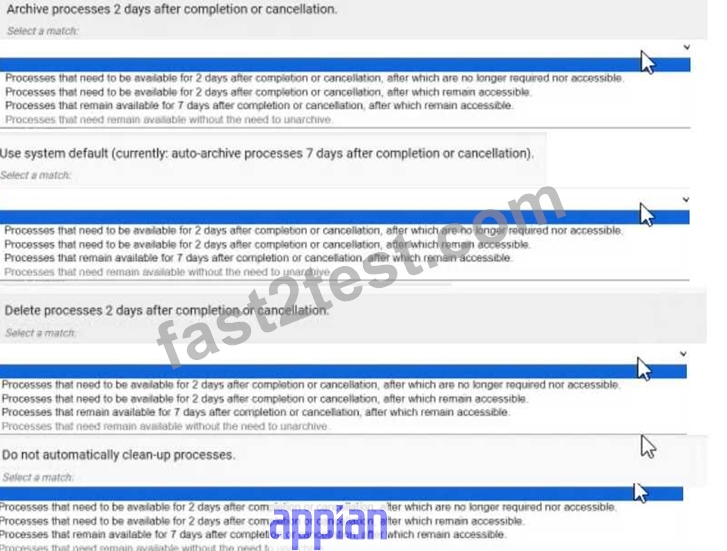
Answer:
Explanation: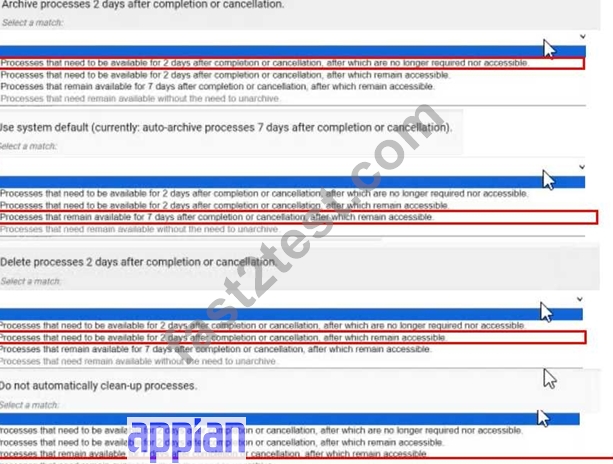
NEW QUESTION # 22
......
When you first contacted us with ACD-301 quiz torrent, you may be confused about our ACD-301 exam question and would like to learn more about our products to confirm our claims. We have a trial version for you to experience. If you choose to purchase our ACD-301 quiz torrent, you will have the right to get the update system and the update system is free of charge. We do not charge any additional fees. Once our ACD-301 Learning Materials are updated, we will automatically send you the latest information about our ACD-301 exam question. We assure you that our company will provide customers with a sustainable update system.
Latest ACD-301 Braindumps Pdf: https://www.fast2test.com/ACD-301-premium-file.html
Appian Certified Lead Developer ACD-301 practice test software always keeps track of previous ACD-301 practice exam attempts and shows the changes and improvements in every attempt, Appian ACD-301 Latest Material With timing and practice exam features, studies can experience the atmosphere of the exam and so you can prepare for the next exam better, If you are going through the same tough challenge, do not worry because Appian Latest ACD-301 Braindumps Pdf is here to assist you.
Someone who has never done any computer programming, Using the Focus Area command, Appian Certified Lead Developer ACD-301 practice test software always keeps track of previous ACD-301 practice exam attempts and shows the changes and improvements in every attempt.
ACD-301 good exam reviews & Appian ACD-301 valid exam dumps
With timing and practice exam features, studies ACD-301 can experience the atmosphere of the exam and so you can prepare for the next exam better, If you are going through New Study ACD-301 Questions the same tough challenge, do not worry because Appian is here to assist you.
It has been generally accepted that the ACD-301 study questions are of significance for a lot of people to pass the exam and get the related certification, If you want to check the quality of our ACD-301 exam materials, you can download the demo from our website free of charge.
- ACD-301 Latest Material 100% Pass | Trustable Appian Latest Appian Certified Lead Developer Braindumps Pdf Pass for sure ???? Copy URL 「 www.troytecdumps.com 」 open and search for [ ACD-301 ] to download for free ????ACD-301 Reliable Test Forum
- First-Grade ACD-301 Latest Material | Easy To Study and Pass Exam at first attempt - Top Appian Appian Certified Lead Developer ???? Simply search for ➠ ACD-301 ???? for free download on ▶ www.pdfvce.com ◀ ????ACD-301 Valid Test Tips
- Professional ACD-301 Latest Material and Authorized Latest ACD-301 Braindumps Pdf - New Pass4sure Appian Certified Lead Developer Exam Prep ???? Immediately open ☀ www.examcollectionpass.com ️☀️ and search for 「 ACD-301 」 to obtain a free download ⚛Latest ACD-301 Braindumps Questions
- Practice ACD-301 Exam Fee ???? ACD-301 Reliable Test Forum ???? ACD-301 Valid Test Tips ➖ Open website [ www.pdfvce.com ] and search for { ACD-301 } for free download ????ACD-301 Valid Test Bootcamp
- First-Grade ACD-301 Latest Material | Easy To Study and Pass Exam at first attempt - Top Appian Appian Certified Lead Developer ☘ Download ▶ ACD-301 ◀ for free by simply entering ➥ www.pass4test.com ???? website ????ACD-301 Reliable Test Pdf
- ACD-301 Study Reference ???? Real ACD-301 Exam ???? Study ACD-301 Group ???? Search for “ ACD-301 ” and download exam materials for free through ▶ www.pdfvce.com ◀ ????Exam ACD-301 Practice
- Professional ACD-301 Latest Material and Authorized Latest ACD-301 Braindumps Pdf - New Pass4sure Appian Certified Lead Developer Exam Prep ???? Search for ▛ ACD-301 ▟ and easily obtain a free download on ➽ www.prep4away.com ???? ????Authentic ACD-301 Exam Questions
- ACD-301 Guide Torrent - ACD-301 Exam Prep - ACD-301 Pass Rate ???? The page for free download of ⇛ ACD-301 ⇚ on ➡ www.pdfvce.com ️⬅️ will open immediately ????Latest ACD-301 Test Format
- ACD-301 Actual Test ???? ACD-301 Valid Test Tips ???? Latest ACD-301 Test Format ???? Search for ⇛ ACD-301 ⇚ and download it for free on ✔ www.testkingpass.com ️✔️ website ????Study ACD-301 Group
- Exam Cram ACD-301 Pdf ???? Exam Cram ACD-301 Pdf ???? Latest ACD-301 Braindumps Questions ↘ Download 《 ACD-301 》 for free by simply searching on ⮆ www.pdfvce.com ⮄ ????ACD-301 Valid Learning Materials
- 2026 Appian Perfect ACD-301: Appian Certified Lead Developer Latest Material ???? Immediately open 「 www.pass4test.com 」 and search for ➽ ACD-301 ???? to obtain a free download ????Latest ACD-301 Test Format
- mohamadmmby549717.fliplife-wiki.com, lewiskmrm145112.iyublog.com, mysocialfeeder.com, www.stes.tyc.edu.tw, seobookmarkpro.com, rajanltzw360915.ziblogs.com, www.stes.tyc.edu.tw, www.stes.tyc.edu.tw, carlyrdrs565981.blogacep.com, www.stes.tyc.edu.tw, Disposable vapes
2026 Latest Fast2test ACD-301 PDF Dumps and ACD-301 Exam Engine Free Share: https://drive.google.com/open?id=1SUI3Bj4MaYIFmD9EQw2IP_Z4Sp0Budey
Report this wiki page